Seller Impersonation Fraud Expands in Scope and Sophistication, ALTA Finds
September 15, 2026
 Seller impersonation fraud (SIF) has become more widespread, sophisticated and financially consequential in just two years, according to new research from ALTA.
The findings, based on responses from 245 title insurance professionals across 40 states, the District of Columbia and the U.S. Virgin Islands, reveal criminals are broadening their targets, adopting new technologies and attempting increasingly complex schemes. At the same time, title professionals continue to strengthen their defenses through layered verification, authentication and fraud-detection practices that help protect consumers and property rights.
Attempts More Than Double
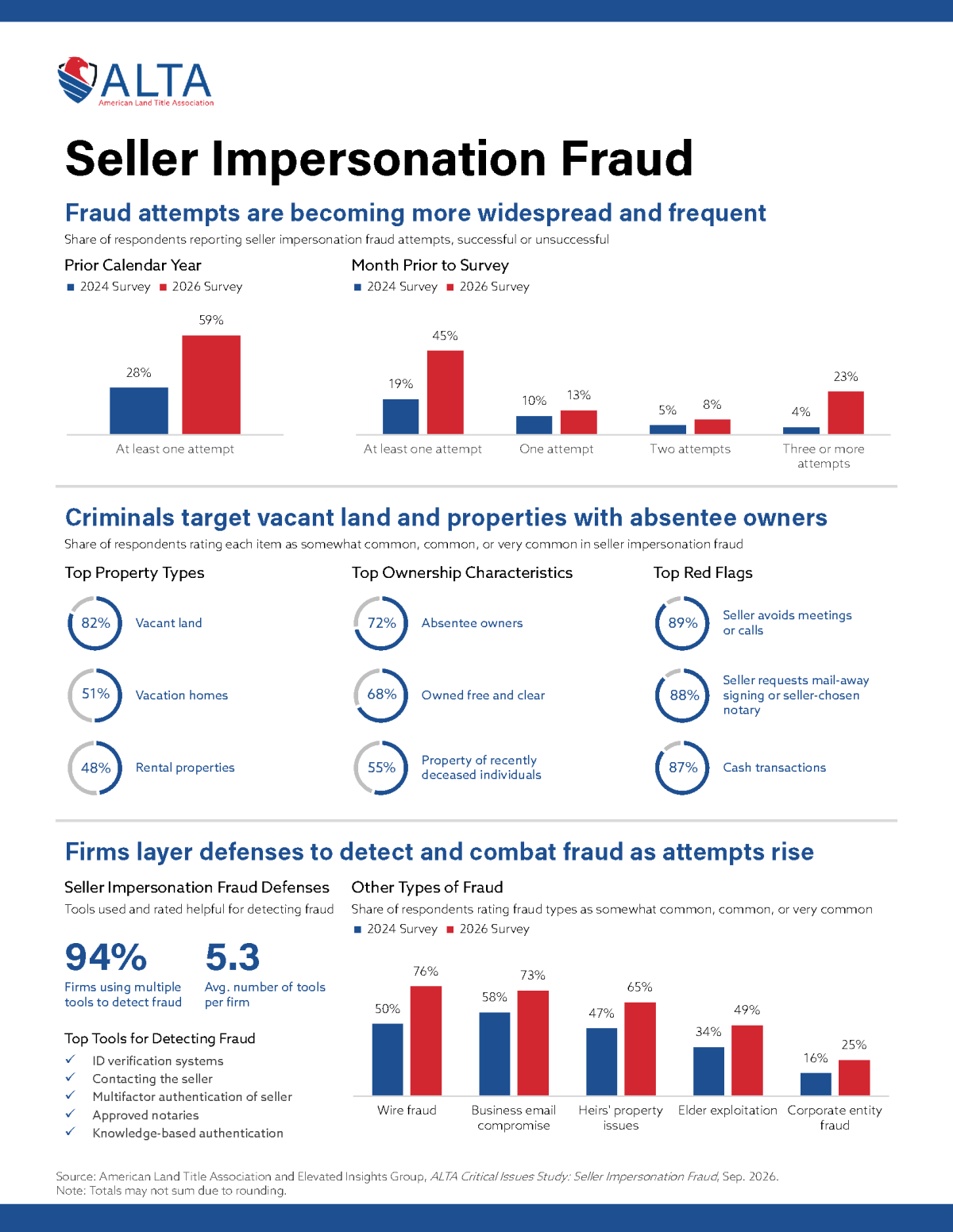
ALTA's latest Seller Impersonation Fraud Study found that 59% of firms reported experiencing at least one seller impersonation fraud attempt in 2025, more than double the 28% reported in ALTA's 2024 study. The frequency of attempts also increased sharply. In April 2026 alone, 45% of firms reported at least one SIF attempt, compared with 19% during the same period two years earlier.
"The findings confirm what title professionals have been telling us for several years—seller impersonation fraud is becoming more common, more sophisticated and more difficult to detect," said Elizabeth Blosser, ALTA Chief Strategy, Communications and Innovation Officer. "Criminals are investing time and resources to exploit weaknesses in real estate transactions, which means our industry must remain equally committed to strengthening safeguards that protect property owners and consumers."
The increase suggests that seller impersonation fraud is no longer confined to isolated markets or occasional transactions. Instead, it has become a persistent threat affecting title professionals across the country.
The study also found that among firms reporting at least one SIF attempt, one-quarter experienced a paid claim related to the fraud. For those reporting claim amounts, the financial impact was significant. Half reported average claim costs exceeding $100,000, while another 42% reported average costs between $25,000 and $100,000.
"When seller impersonation fraud succeeds, the consequences can be devastating," Blosser said. "Beyond the financial losses, these schemes can create significant legal challenges and emotional stress for property owners and buyers. Preventing fraud before a transaction closes is always better than trying to unwind the damage afterward."
Fraudsters Are Broadening Their Targets
Vacant land remains the most common target for seller impersonation fraud, with 82% of respondents identifying it as a frequent characteristic in attempted schemes. However, the study indicates fraudsters are increasingly looking beyond undeveloped property.
Vacation homes (51%), rental properties (48%), agricultural land (36%) and even primary residences (25%) all experienced notable increases as targets compared with the 2024 survey. The findings suggest criminals are casting a wider net in search of vulnerable transactions.
The research also highlights ownership situations that fraudsters find attractive. Nearly three-quarters of respondents identified absentee owners as common targets. Properties owned free and clear of a mortgage ranked close behind (68%), while more than half of respondents said properties belonging to recently deceased individuals were frequently targeted.
"Fraudsters are no longer focused solely on vacant land," Blosser said. "We're seeing criminals target a wider range of properties and ownership situations, including absentee owners, properties owned free and clear, and properties connected to recently deceased individuals. That evolution underscores why every transaction deserves careful scrutiny."
Technology Is Changing the Fraud Playbook
The study found evidence that seller impersonation fraud is becoming increasingly sophisticated as criminals leverage technology and publicly available information to support their schemes.
Spoofed contact information emerged as the most commonly reported tactic, with 87% of respondents identifying it as a common component of fraud attempts. Fraudsters also continue to rely on legitimate personal information, including birth dates, Social Security numbers and financial information, to establish credibility.
Perhaps most concerning is the emergence of deepfake technology. Nearly six in 10 respondents reported that manipulated voice or image technology is becoming a common feature of seller impersonation fraud attempts. While traditional warning signs remain important, advancing technology is making it easier for criminals to create convincing identities and communications.
"The use of spoofed communications, stolen personal information and emerging technologies such as deepfakes demonstrates how quickly these schemes are evolving," Blosser said. "While the tools used by criminals may change, the industry's commitment to verifying identities, validating ownership and protecting consumers remains constant."
Recognizing the Red Flags
Despite evolving tactics, many of the most reliable warning signs remain consistent. The leading red flag identified by respondents was a seller who avoids meetings, phone calls or video conversations. Requests for mail-away signings using the seller's preferred notary also ranked among the most common indicators of suspicious activity.
Other frequently cited warning signs included cash transactions, properties with no existing mortgage or encumbrance, below-market sale prices and unusual seller behavior during communications. Recognizing these indicators early can provide title professionals with valuable opportunities to conduct additional verification before a transaction progresses.
Layered Controls Provide Protection
As fraud attempts increase, title professionals continue to rely on multiple layers of protection to verify identities and detect suspicious activity. The study found that nearly all respondents considered at least one fraud-prevention tool useful, while 94% rated multiple tools as effective in combating seller impersonation fraud.
Among the highest-rated tools were identity verification systems (92%), direct contact with sellers through independently verified channels (90%), multifactor authentication (89%), approved notary networks (88%) and knowledge-based authentication (86%).
The findings reinforce a fundamental lesson in fraud prevention that no single tool is sufficient on its own. Instead, successful detection often depends on combining multiple verification methods to validate identity, confirm ownership and identify inconsistencies before funds are disbursed or deeds are recorded.
Firms reporting greater confidence in their preparedness also tended to use a broader array of fraud-detection tools and maintain formal coordination with listing agents regarding seller identity verification.
As criminals expand their targets and adopt more sophisticated tactics, the title insurance industry continues to adapt. Through investments in technology, robust verification procedures and experienced professionals trained to identify suspicious activity, title companies serve as a critical line of defense against increasingly complex fraud schemes.
"The study highlights the critical role title professionals play in protecting property rights and preserving confidence in real estate transactions," Blosser said. " In an environment where criminals are becoming more sophisticated, vigilance, expertise and layered defenses remain among the industry's most effective tools. Every day, title companies combine technology, industry expertise and rigorous verification processes to identify suspicious activity and stop fraud before consumers are harmed.”
Contact ALTA at 202-296-3671 or [email protected].