Protecting Democracy and Capitalism: Economist Makes Case for Title Industry’s Role at ALTA Advocacy Summit
May 12, 2026
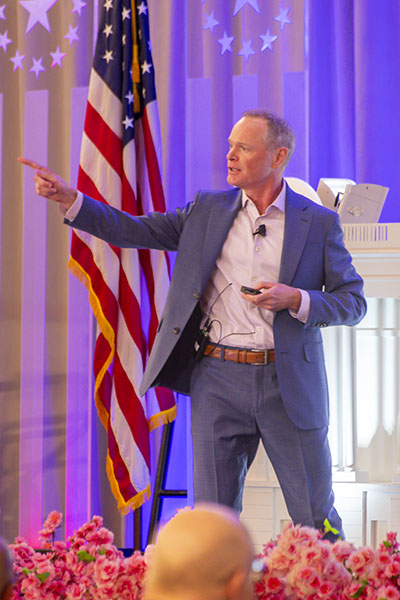 The title insurance industry does far more than facilitate real estate transactions. It protects property rights, prevents fraud and helps sustain the economic framework that supports homeownership and wealth creation in the United States.
That was the central message delivered by First American Financial Chief Economist Mark Fleming during the opening general session at the 2026 ALTA Advocacy Summit in Washington, D.C. Framing the discussion through both economics and public policy, Fleming argued the title industry’s work is foundational to what makes the American real estate market function.
“We protect democracy and capitalism,” Fleming said.
Fleming described property rights as one of the core building blocks of economic prosperity. Citing estimates valuing the U.S. residential real estate market at roughly $55 trillion, he said clear and enforceable ownership rights are essential because they allow consumers to borrow against property, transfer wealth and build long-term financial stability.
“Housing is the single largest source of wealth creation for most American families,” Fleming said. “If you have clear property rights, you can borrow against them, transfer them and create prosperity.”
He emphasized that the title industry plays a unique role in maintaining the integrity of the public record. Unlike many countries that rely on government-backed land registries, the United States operates through a public recording system where ownership ultimately depends on contracts, legal documentation and curative work performed during transactions.
Fleming warned that if the title industry stopped performing that curative function, the consequences would be severe. Drawing on research conducted by First American Financial, Fleming said the industry mitigates between $600 billion and $1 trillion in annual exposure tied to defects, liens, recording issues and other title-related risks that otherwise could result in claims or ownership disputes.
“We insure what we cure,” Fleming said. “That means consumers are protected before problems become losses.”
He pointed to the sheer volume of activity affecting title clarity each year, including millions of judgments, liens, foreclosures and tax-related filings that can cloud ownership rights or complicate transfers.
Fraud prevention also featured prominently in Fleming’s remarks. Referencing recent FBI data, he noted that reported losses tied to real estate fraud exceeded $275 million in 2025, while business email compromise schemes generated more than $3 billion in losses across industries.
“This is what title professionals combat every day,” Fleming said. “Without us, those numbers would be much worse.”
Fleming also pushed back against criticisms that title insurance is overly expensive or outdated. Using data adjusted for home-price inflation, he argued title premiums have effectively declined over the last decade even as transaction complexity and fraud threats have increased. According to Fleming, title insurance represents less than 1% of the total cost of homeownership over a typical seven-year ownership period.
For attendees preparing to meet with lawmakers during the summit, Fleming urged the industry to communicate its broader value proposition more clearly.
“Our story is homeownership,” he said. “Our story is protecting property rights, protecting consumers and protecting the system that allows real estate markets to function.”
Fleming also addressed ongoing debate surrounding the Financial Crimes Enforcement Network residential real estate reporting rule, arguing that while combating money laundering is important, the current framework captures too many low-risk transactions and creates operational friction for consumers and settlement professionals alike.
Using data from ALTA surveys, he noted that consumers expressed significant concern about providing sensitive financial information and that many transactions experienced delays under the reporting framework.
“If we want this to work, it has to be more targeted and more efficient,” Fleming said.
Closing his remarks, Fleming encouraged title professionals to continue advocating for the industry at both the state and federal levels.
“People are making decisions without fully understanding what we do,” he said. “We just need to educate them.”
Contact ALTA at 202-296-3671 or [email protected].