The Great Transaction Heist: How Title Professionals Must Respond to Wire Fraud
March 19, 2026
 Wire fraud in real estate is no longer the work of opportunistic scammers. It has evolved into a sophisticated, global enterprise. One that is faster, smarter and often better organized than many in the industry understand.
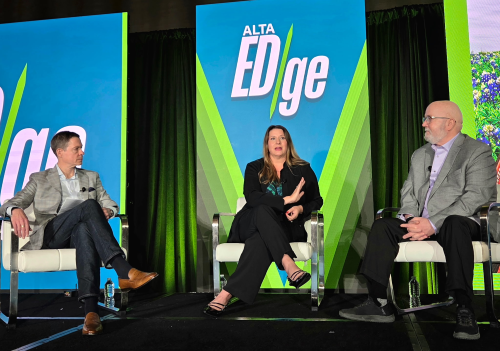
That was the stark message delivered to more than 400 attendees during the ALTA EDge session, “The Great Transaction Heist: Inside Modern Wire Fraud,” where Sarah Frano, vice president of corporate underwriting at First American Title Insurance Co., and Bruce Phillips, senior vice president and chief information security officer at WFG National Title Insurance Co., pulled back the curtain on how modern fraud operations really work. Moderated by ALTA CEO Chris Morton, the discussion made it clear title professionals are on the front line of a rapidly escalating battle.
Today’s Fraudsters Are Not Amateurs
Forget the stereotype of a lone hacker in a basement. Today’s adversaries operate like full-scale businesses.
“These are criminal organizations,” Phillips said. “They have HR departments, developers and business models. Some even recruit top technical talent.”
In fact, fraud has become so accessible that even non-technical criminals can participate. Tools, stolen identities and even money-laundering services are readily available for purchase on the dark web. The barrier to entry is low, while the return on investment is extraordinarily high.
The result? There is a growing ecosystem of bad actors from organized international groups to entrepreneurial fraudsters who are targeting real estate transactions because of the large sums of money involved.
Speed and Scale Are the New Threat
If there is one defining characteristic of modern fraud, it is speed.
Powered by automation and artificial intelligence, criminals can adapt in real time by testing vulnerabilities, refining tactics and launching new attacks in minutes.
“They are using AI, and they’re using it better than we are,” Phillips warned.
This creates a dangerous imbalance. While fraudsters iterate rapidly, the title industry often struggles to implement even basic process changes.
An Industry Struggling to Keep Up
Frano didn’t mince words when assessing the industry’s readiness.
“Many title and settlement professionals are used to processes that worked in the past,” she said. “But we don’t live in that world anymore.”
She pointed to three core challenges:
- Technology gaps: Many companies lack modern verification tools or fail to keep systems updated.
- Process inertia: Implementing new procedures takes time and fraudsters move faster than adoption cycles.
- People and mindset: Most critically, there is a persistent belief that “it won’t happen here.”
That mindset is dangerous. Fraudsters are not targeting specific properties. They are targeting money. Every transaction is a potential opportunity.
The Human Element: Social Engineering Wins
While cybersecurity tools are important, the biggest vulnerability isn’t technical. It’s human.
“What really costs us money is social engineering,” Phillips said. “It’s convincing you to do something you normally wouldn’t do.”
Whether it’s a spoofed email, a fake phone call from a “bank,” or a highly convincing impersonation, these attacks exploit trust, urgency and the industry’s customer-service mindset.
Frano described title professionals as “relationship builders” who are trained to get deals done. That instinct, while valuable, can become a liability.
“Many are susceptible to becoming the ‘golden retriever with a flashlight,’ unwittingly helping the bad actor find another way in,” she said.
Instead of stopping when red flags appear, professionals may pivot to keep the transaction moving. This behavior unintentionally enables the fraud.
A Dangerous Disconnect Around Risk
Another challenge is the lack of direct consequences for many employees involved in transactions.
“When you don’t have skin in the game,” Frano explained. “You may be more prone to overlooking risks and possible red flags.”
This can lead to risky decisions, especially in a tight market where closing deals is critical. Real estate agents, lenders and even title staff should remain diligent and be on the alert for warning signs.
But when fraud does occur, the consequences are severe. Businesses can lose millions. And, in some cases, face closure within hours.
The Rise of Account Takeovers and Identity Fraud
Beyond traditional wire fraud, panelists highlighted a surge in account-takeover attacks and synthetic identity fraud.
Criminals now have access to vast amounts of personal data, making traditional verification methods, such as knowledge-based authentication (KBA) obsolete.
“Assume everyone in the transaction is compromised from the beginning,” Phillips advised.
That includes buyers, sellers, agents and even internal staff systems.
Tools Are No Longer Optional
Despite the growing threat, many companies still fail to adopt basic safeguards.
Panelists emphasized that wire verification and identity verification tools are now non-negotiable. Relying on manual processes or simply trusting emailed instructions is no longer defensible.
Courts are beginning to reflect this reality. According to Frano, there is a shift toward holding title professionals accountable when available tools are not used.
“If there are resources and technologies available and you’re not utilizing them, that can be construed or perceived as negligence,” she said.
When Fraud Happens, Time Is Everything
Even with strong defenses, fraud can still occur. When it does, response time is critical.
“You have the best chances to recover funds in the first 24 hours,” Frano said. “After that, the chances drop dramatically.”
Every company should have a clearly defined, well-rehearsed response plan. Frano describes this as the industry’s version of “stop, drop and roll.”
“If you have a plan and no one knows where it is or how to use it, you might as well not have one,” Phillips added.
Key Takeaways for Title Professionals
The session closed with urgent, practical advice:
Stop doing this immediately:
- Verifying wire instructions using phone numbers provided in emails or documents within the transaction.
- Relying on outdated authentication methods like KBA.
- Assuming experience predicts future risk.
Start doing this now:
- Assume every transaction is compromised from the outset.
- Implement wire and identity verification tools across all transactions.
- Train employees regularly and test fraud response plans at least quarterly.
- Treat cybersecurity as a core business expense, not an optional add-on.
A Turning Point for the Industry
The most sobering takeaway is that this is no longer a theoretical risk.
“It’s going to happen to you,” Phillips said. “If you’re not prepared, you’re going to lose.”
Wire fraud is not just a financial threat. It’s an existential one. It impacts consumer trust, industry reputation and the long-term viability of businesses.
For title professionals, the message from ALTA EDge was unmistakable: adapting is no longer optional. The question is no longer if fraud will occur, but whether the industry can evolve fast enough to stop it.
Resources
Contact ALTA at 202-296-3671 or [email protected].