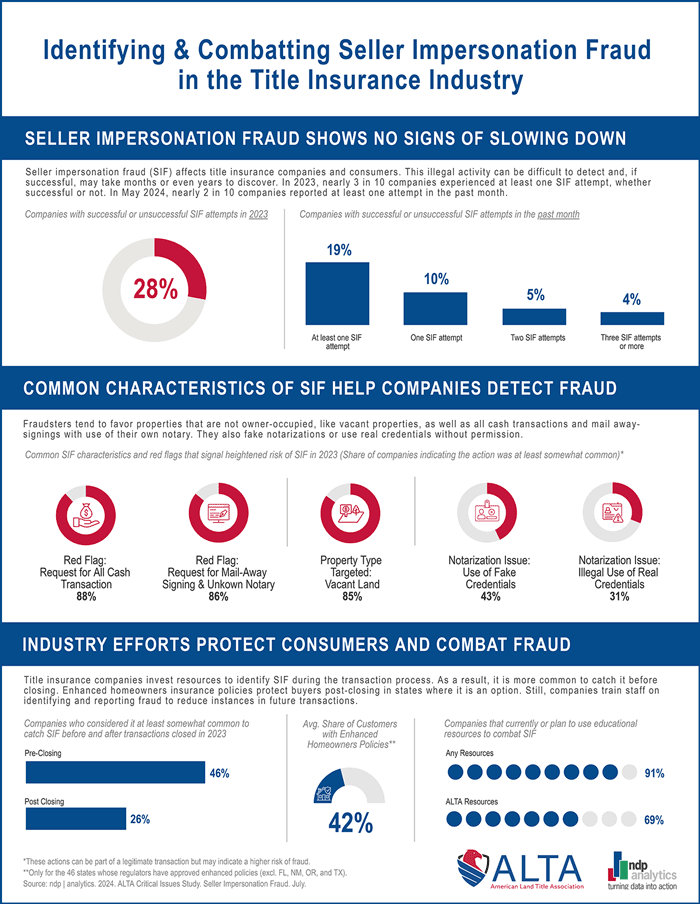
Seller impersonation fraud remains a growing threat to real estate transactions. To better understand how these schemes are evolving, ALTA surveyed 245 title insurance professionals across 40 states, the District of Columbia and the U.S. Virgin Islands in spring 2026. Building on ALTA's 2024 research, the study examines emerging fraud tactics, financial impacts and the tools title professionals use to protect consumers and property rights.
Made possible by

Access This Research
Log In to Download this Report Or fill out the form below, and we will email it to you.
The key findings are:
- Fraud exposure increased substantially. In 2026, 59% of firms reported at least one seller impersonation fraud attempt in the prior calendar year, up from 28% in 2024. The share reporting an attempt in the prior month rose from 19% to 45%.
- Financial losses can be substantial. One in four firms reporting a fraud attempt also reported a paid claim related to seller impersonation fraud. Among those reporting a paid claim and disclosing average costs, half reported costs above $100,000.
- Criminals are broadening their targets and tactics. Vacant land remained the top target of fraud, while properties with absentee owners, properties owned free and clear, and properties associated with recently deceased owners were also common targets. Avoiding meetings or calls and requesting mail-away signings or a seller-chosen notary were leading red flags.
- Firms use layered defenses. 94% of firms used multiple tools that they considered helpful for detecting fraud, averaging 5.3 per firm. ID verification, direct seller contact, and multifactor authentication were the highest-rated tools.
- Seller impersonation fraud is part of a broader fraud challenge. Among other types of fraud, firms most commonly encountered wire fraud and business email compromise, while heirs’ property issues, elder exploitation, and corporate entity fraud were reported more frequently than in 2024.